Details
Contributors

Focus
Article
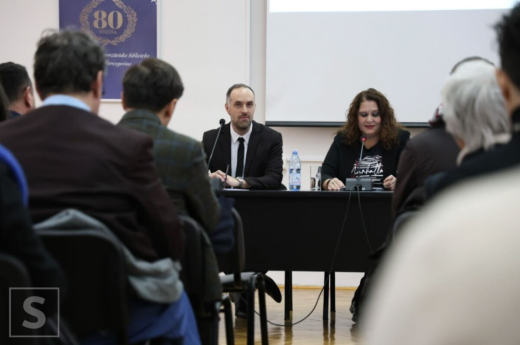


The National and University Library of Bosnia and Herzegovina (NULBiH) has officially presented Bosnian Language for Non-Native Speakers (A1/A2), a groundbreaking new textbook authored by Dr. Jasmin Hasić, Senior Fellow and former Executive Director of HIA BiH. The publication was released by the Pedagogical Institute of the Una-Sana Canton and represents a major step forward in the internationalization and standardization of Bosnian language education.
Designed for beginners, the textbook offers a structured, accessible, and culturally rich introduction to learning Bosnian as a foreign language. It successfully balances grammatical precision with learner-friendly clarity and is fully aligned with CEFR (Common European Framework of Reference for Languages) standards. As such, it fills a long-standing gap in Bosnian studies and provides a modern foundation for teaching Bosnian to non-native speakers worldwide.
A Modern, Intercultural Approach
At the presentation, key elements of the textbook were highlighted, including its contemporary pedagogical methodology, clear progression of linguistic complexity, a rich and diverse selection of exercises, and a distinct intercultural dimension. Beyond language mechanics, the textbook introduces learners to Bosnian cultural and social contexts, strengthening both linguistic competence and cultural understanding.
The first electronic edition, available free of charge online, marks the beginning of a broader vision. According to Dr. Hasić, this project is not a standalone achievement but part of a long-term, systematic effort to develop Bosnian as a standardized foreign language for learners of all ages.
Responding to Growing Global Demand
Dr. Hasić emphasized that interest in learning Bosnian is steadily increasing, both within Bosnia and Herzegovina and internationally, particularly among foreign residents, members of the Bosnian diaspora, and individuals with personal or professional ties to the country.
“This textbook is a concrete step forward,” Hasić noted. “It is freely accessible online and written in accordance with the European reference framework for languages. However, the broader vision of Bosnian as a foreign language cannot be realized without coordinated institutional support.”
He further underscored the importance of language certification as a critical next phase in the standardization process, which would allow Bosnian to be more fully integrated into international academic and educational systems.
Strengthening Institutional Presence
While Bosnian has a large number of speakers globally, Dr. Hasić pointed out that it remains underrepresented academically, with relatively few university departments or dedicated programs abroad. Historically, during the Yugoslav period, Bosnian existed within the broader framework of Serbo-Croatian. After the dissolution of Yugoslavia, Serbian and Croatian achieved stronger academic institutionalization, while Bosnian remained in an underdeveloped transitional space.
The publication of this textbook directly addresses that gap.
International Impact and Strategic Leadership
Dr. Hasić also recognized the role of Federal Minister of Education and Science Jasna Duraković, praising her leadership in promoting Bosnian as a foreign language. Through successful negotiations in Türkiye, a new Bosnian language department will open in February, marking a major milestone.
Minister Duraković emphasized that the textbook brings multiple benefits, describing it as a significant and high-quality publication aligned with international language-learning frameworks. She also highlighted the strategic importance of the newly established Bosnian Language and Literature Department at Istanbul University, where over 100,000 students will have the opportunity to study Bosnian as an elective subject.
A Lasting Contribution
Bosnian Language for Non-Native Speakers (A1/A2) is more than a textbook. It is a strategic cultural and educational intervention. Through scholarly rigor, institutional collaboration, and public accessibility, Dr. Jasmin Hasić has made a lasting contribution to Bosnian linguistics and to the global visibility of Bosnia and Herzegovina.
This initiative reinforces Dr. Hasić’s broader legacy as a scholar, policy leader, and advocate for sustainable cultural and educational development, advancing Bosnian language learning from the local to the global stage.